Most writing about AI coding agents measures them by output: pull requests opened, lines written, tickets closed. That treats more code as the goal. For a product that has to win users, more code is only a cost.
astro-ai, the codebase behind shubhagya.com, runs a team of fifteen Claude Code agents on GitHub Actions, and they are pointed at one sentence instead of a backlog:
Move the 6–20 position band into the top 5 on the ten highest-impression queries.
That is the whole objective. Pages that Google ranks at positions 6 to 20 are one or two places off page one, so moving them up needs no new content, only better pages. The north star behind it is organic sessions.
This post walks through how that loop works: how it measures, decides, builds, verifies, ships and scores its own work against the objective. It also covers how it is monitored, what it shipped between 8 October and 1 November 2026, and the plumbing failures that still keep it from running fully on its own. The agent cycle page has the interactive map, if you want to see it first.
Start from an objective, not a backlog#
Six groups of agents run on separate schedules and never see each other's
working memory. Without a shared target, each one maximises its own output, and
OBJECTIVE.md
names the local optima it refuses:
- Analytics must not report only what moved. A ship that did nothing is the most useful finding of a cycle.
- Growth must not file issues to look productive. Discovery is capped at 30 issues a cycle, and an issue without a complete evidence block is not work.
- Engineering must not ship volume. "A merged PR that moved no metric and broke nothing is a neutral outcome, not a good one."
- Design must not redesign a page that already ranks without a CTR or funnel number to beat.
There is also a rule for when growth and accuracy collide, which matters for a site making astrological claims: "Authenticity wins on the claim; traffic wins on the roadmap." A claim that cannot be sourced is corrected or qualified, even if the page performs.
The objective is what turns a coding agent into a growth system. It decides what gets built, and it is what every ship is later scored against.
The loop, stage by stage#
The agents are Claude Code subagents, each with its own prompt, tools and permissions, run by GitHub Actions on a schedule. The scheduled loops never talk to each other. Every handoff between them is something durable, like an issue comment, a label or a commit, which the merge-authority post covers in detail. Inside a single delivery cycle, the cycle hands work to its engineer and QA subagents directly.
One turn of the growth loop
Measure
daily, collectors 7 more times · agent-measure
Fetch GA4 and Search Console; the analyst reports the band and scores past ships
Discover
weekly · agent-discover
product-manager reads the analyst first, then files issues with a complete evidence block
Prioritise
weekly · agent-prioritise
project-manager ranks the backlog and closes what is already fixed or stale
Build and QA
6× a day since 1 Nov · agent-work
Probe production where the issue has a repro, build, then a separate QA agent writes a verdict
Merge
on events + sweep · agent-merge
A workflow merges on evidence: green gates, a qa-pass bound to the head commit, protected paths cleared
Deploy and verify
on push · verify-production
Cloud Build deploys main; a sweep checks the live site and /health reports the commit serving
Close and score
close-on-evidence · analyst
close-on-evidence closes the issue; weeks later the analyst scores it against its own thesis
Three parts of it carry most of the weight.
Every issue states what it should move#
Discovery may file an issue only with a complete evidence block, which
discover.md
spells out: GA4 or Search Console numbers with an explicit window, the
competing page and keyword, a source citation for any astrological claim,
measured token cost, a reproduction, a thesis and the metric that will judge
it.
The thesis and metric are the important part. They are written before anything is built, so the outcome can be checked against a prediction rather than against a story told afterwards.
Production is probed before anything is built#
When an issue carries an executable reproduction, a cycle tests it against the
live site first. validate_issue.py sends five varied probes to production. If
none reproduces the problem, the cycle closes the issue with all five samples in
the comment instead of building a fix for something that is not broken.
Most of the backlog has no executable repro, and then nothing is probed. The cycle has to establish the premise some other way before building, and an issue it could not probe is never closed on that basis.
The loop grades its own ships, misses included#
The analyst runs daily and scores every closed issue that carries a thesis:
and a metric: line. Its 2 November report found 40 such issues, of which only
6 had a metric GA4 or Search Console could read. Three of the six show the
range:
- #311, rewriting titles and meta descriptions on four band pages, predicted a combined click-through rate of at least 1.5%. It measured 0.81%. The report calls it a miss and tells the loop not to file "rewrite more titles" on the strength of the idea.
- #276, a call to action placed early on one article, crossed its bar of 1.20 pages per session, at 1.47 on 38 sessions. The analyst marked it provisional, because the window mixes days before and after the deploy.
- #329 had too few sessions to read either way, and the report says the metric itself is probably unscoreable.
That is the behaviour the objective asks for, and it is rare in human teams too. A loop that cannot report its own misses has no way to stop repeating them.
How it is monitored: the ops dashboard#
A loop that runs while nobody watches needs a page that tells the truth about
it. astro-ai has one at /admin/ops, built from the measurement files the loops
commit, plus three tiles fetched live from GitHub.
The screenshots below are a local render of that page from the repository at
eb1277a,
taken on the morning of 2 November. I removed one banner that only appears on a
local render, which has no production LLM statistics. Everything else is as the
page draws it. Select a screenshot to open it at full size.
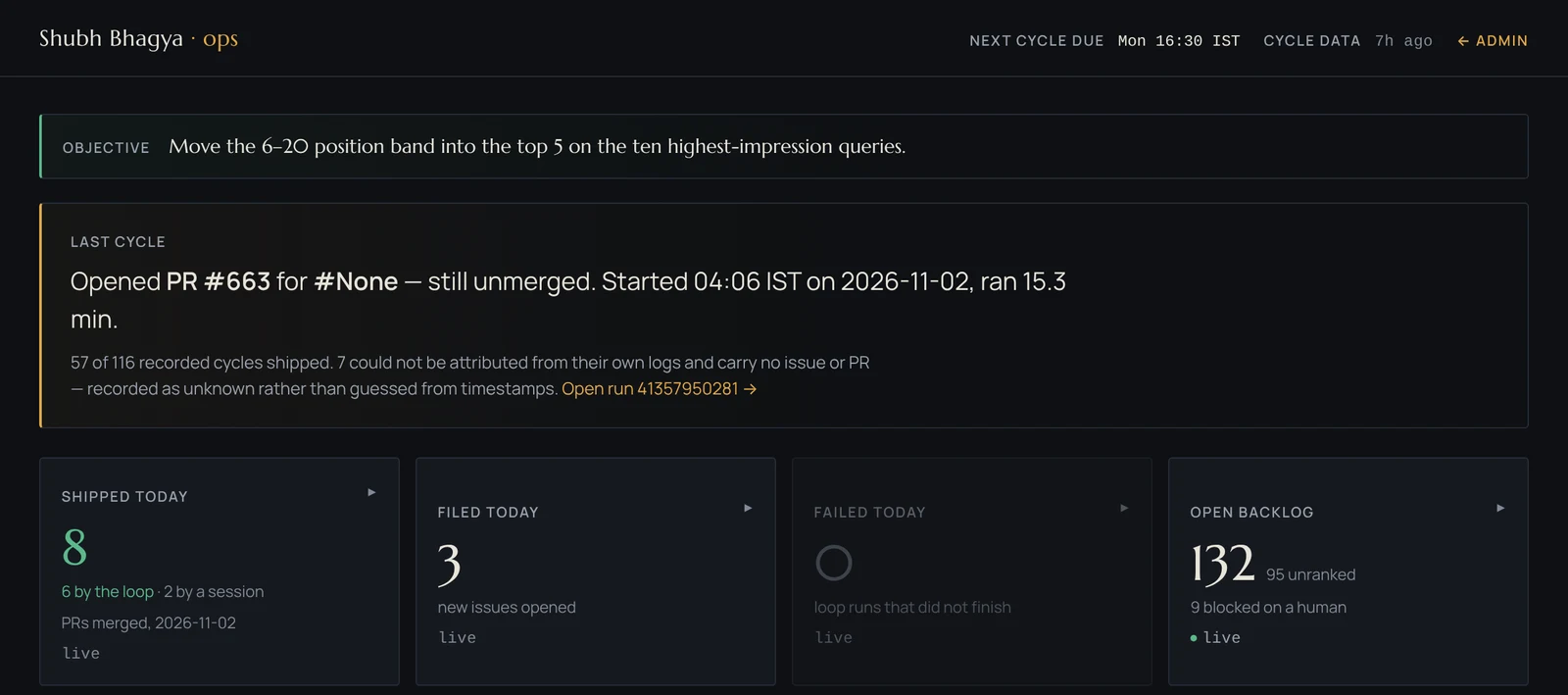
The first tile reads 8 pull requests merged that day, 6 by the loop and 2 by a session run by hand. The backlog tile carries the number that matters most for autonomy: 9 issues blocked on a human.
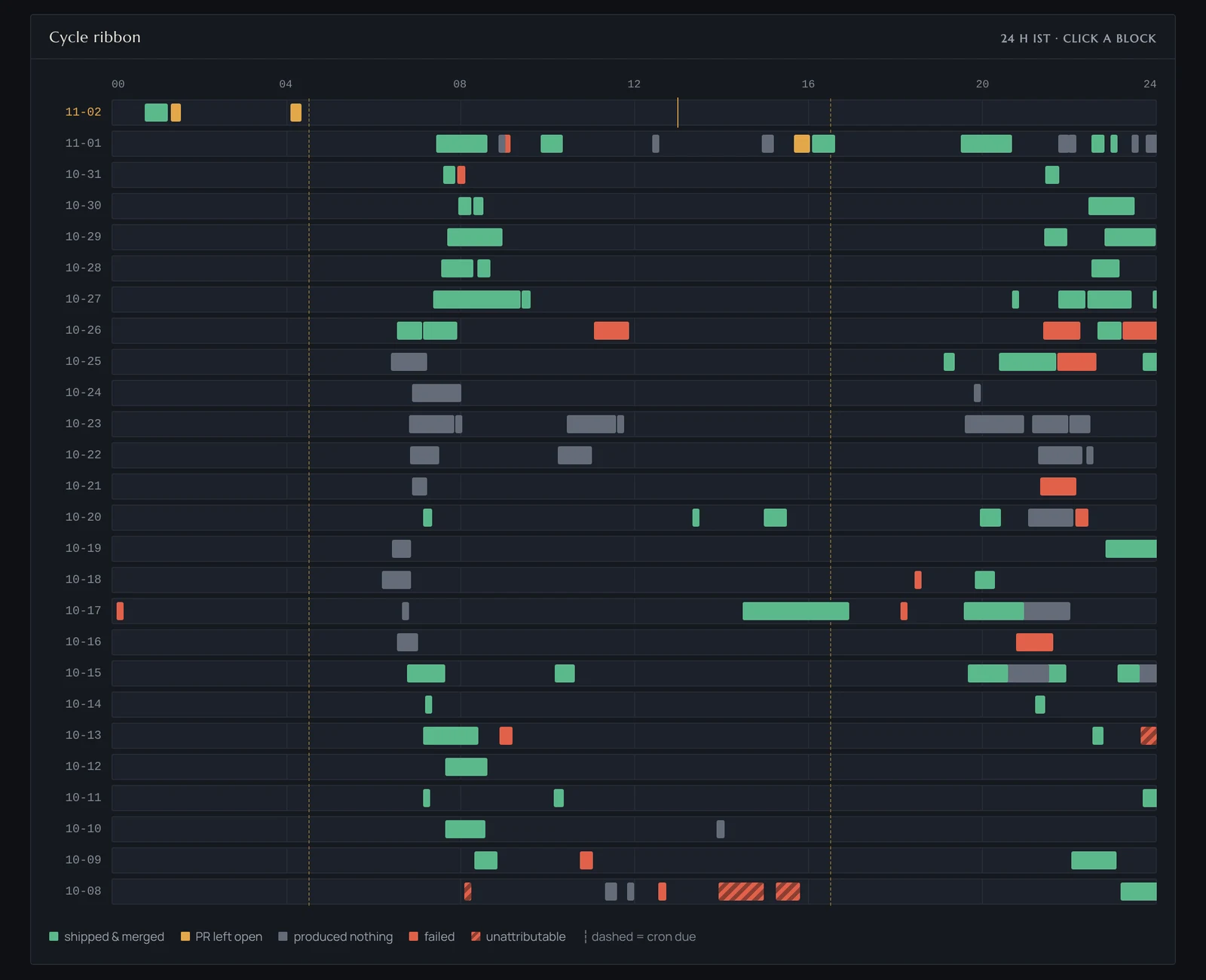
The ribbon is the most useful view on the page, because it shows a stall at a glance. From 22 to 24 October (UTC), 13 cycles ran and none picked up any work at all. The ribbon shows that something stopped; it does not say why.
The repo's
CLAUDE.md
records two faults across the same days. From 21 to 25 October every code pull
request waited for a human, because the merge workflow selected pull requests
by branch name. And the steward, the agent that unblocks stalled work, was
standing down twice a day because its own instructions carried a stale copy of
that rule. Both were fixed on 25 October, and the ribbon turns green again from
that day. Which fault caused which grey block, the records cannot say.
What the dashboard was built to catch#
The scripts behind it state their main design principle in their header: "The dominant failure in this system is silence, not bad work." On 14 October, two of fourteen workflows had a red latest run and one had never run at all, and nothing anywhere showed it. So the page reports in a fixed order:
- Liveness. Did each loop run when its schedule said it was due? A loop that was never due is reported as not due yet, not as dead.
- Yield. When it ran, did anything come out?
- Agents. When nothing came out, which agent stopped?
Two lessons from building it apply to any agent dashboard:
- A committed snapshot cannot answer "what happened today". On 18 October the three "today" tiles read 0, 0 and 0 from a file written on the 15th, while five loop runs had failed. Those tiles are now fetched live, and each falls back to the snapshot with a visible label when GitHub cannot be reached.
- Zero is not a clean bill of health. A yield computed over zero runs looks like a perfect 0 out of 0. A comment parser that silently matches 40% of its input looks identical to one that matches all of it, so unmatched comments are counted and shown, never dropped.
One limit is stated in the same header. Per-agent figures are parsed from the agents' own comments, so they catch an agent that stops or crashes, but not one that writes a confident comment and does nothing. The defence against that is the gates, which judge the code rather than the story about it.
What it shipped, and what it cost#
From the delivery records in
measurements/loop.json,
covering 8 October to 1 November 2026:
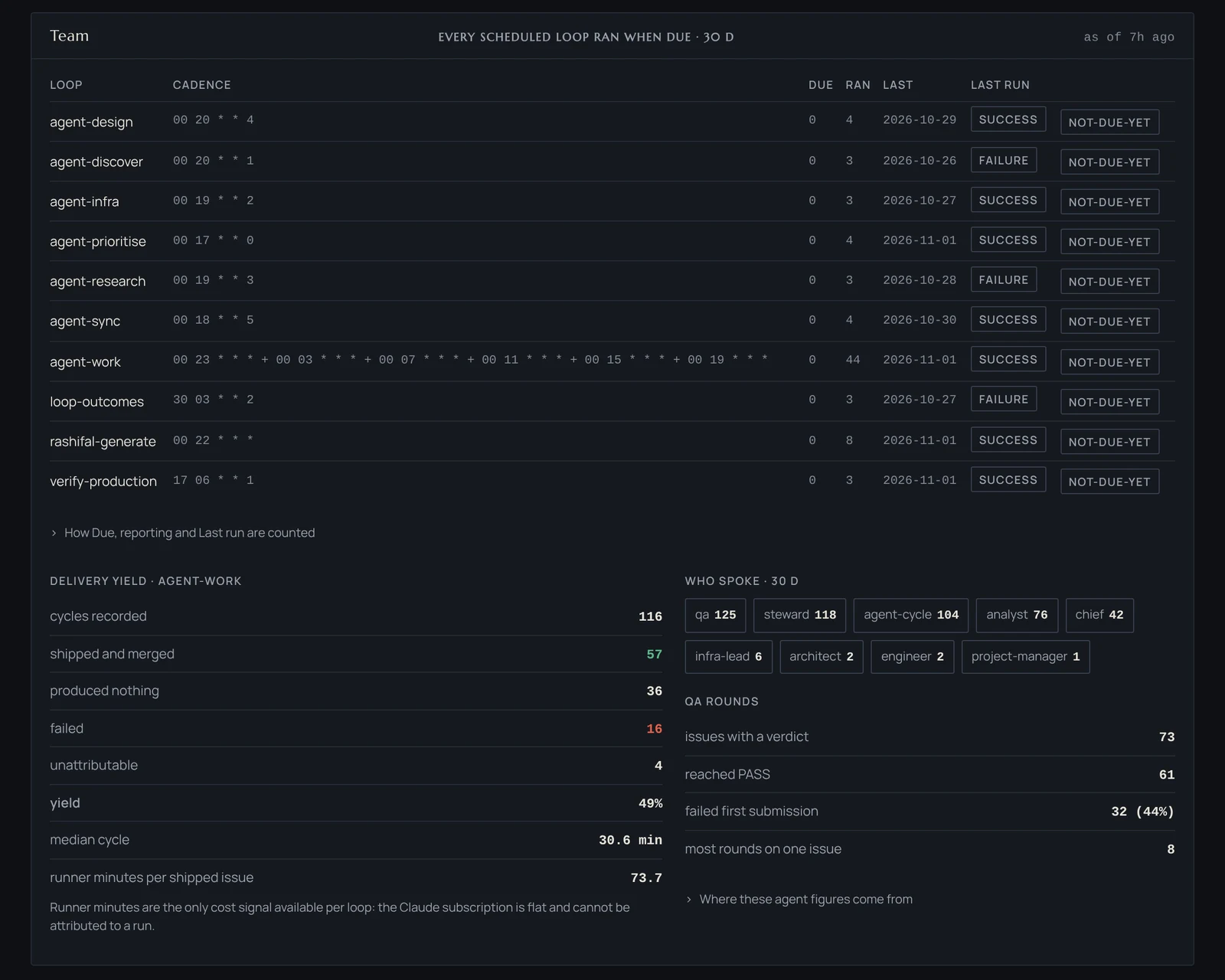
57 cycles ended in a merged pull request, 43 of them distinct, because a second cycle often finishes a pull request a first one opened. 36 produced nothing, 16 failed, 3 left a pull request open, and 4 could not be attributed from their own logs. The records list those 4 as unknown rather than guess them from timestamps. In the seven days to 1 November, 43 cycles produced 21 distinct merged pull requests.
The records say which pull requests merged, not who pressed the button. For part of the window, 21 to 25 October, merges waited for a human, as described above. And not every cycle was scheduled: until 1 November the delivery loop's cron fired at most twice a day, and 69 of the 116 cycles were started on demand, by a person, by the steward, or by the workflow that starts QA when a pull request goes green.
QA is where much of the value shows. Over the last 30 days 73 issues reached a QA verdict, 61 passed, and 32, or 44%, failed their first submission. Those 32 would otherwise have gone to a site with no staging environment, protected only by the automated gates. Most of those rounds are the cycle's own QA step rather than a fully independent review, and the repo labels each verdict with which it was, because the two do not carry the same weight.
The running cost is small because the design was built around it, the same constraint the free-tier post describes:
| Item | Monthly cost | Basis |
|---|---|---|
| Claude Max 5x | $100 | Flat subscription that funds every agent run |
| GitHub Actions | $0 | Public repository |
| Groq (the app's own LLM) | $0 | Free tier, 8,000 tokens per minute per model |
| GA4 and Search Console | $0 | Free |
| OpenAI | unknown | Paid fallback at the end of the app's LLM chain |
| Google Cloud | unknown | Cloud Run, storage and builds |
GitHub Actions has been free since the repository went public on 12 October.
The two unknown lines have no figure because nothing in the project reads that
spend yet, and
cost.json
records them as unknown rather than zero.
Did it grow anything?#
Search impressions roughly doubled. Across two 28-day windows, Search Console shows 15,940 impressions and 173 clicks for 3 to 30 October, against 8,202 and 86 for the four weeks before.
The analyst does not let the loop take credit for that, and neither will I. Its report finds the rise concentrated on three pages and arriving mostly from 23 October, with average position flat at 6.6 to 7.5 throughout. Diwali falls on 8 November, so a seasonal effect cannot be ruled out. Several pull requests touched the same pages in the same window, so no single change can be credited. And the objective itself is "not measurable as written": it names queries, but Google returns query-level data for only 11% of impressions.
So the loop is honest about the thing it is for. It ships steadily, scores what it ships, and has not yet shown that it moves the band. The next useful step is fixing the measurement, not shipping more. Issues are open for page-by-day exports and click events, and the objective itself needs rewording to something Search Console can actually report.
What still breaks on the way to full autonomy#
The loop is close to running without me. The failures that remain are almost never bad code. They are the plumbing between steps, and the pattern is consistent: something stops, and nothing says so.
- A protection rule broke six workflows at once.
maingained branch protection on 15 October, and all six workflows that pushed straight tomainstopped being able to.agent-measure, which runs most often, failed about 40 times in six days while the dashboard went on showing 14 October's numbers as current. The weekly ones had not hit it yet. All six now publish through a pull request that merges itself. - Green pull requests stranded. The merge workflow woke on events, and when the last check finished after the last event, nothing asked again. A 30-minute safety sweep was added, and measured gaps of two to seven hours between its runs. The merge-authority post has the full account.
- A rule copied into prose kept running after the code changed. After the
merge gate stopped caring about branch names, the agents' instructions still
said to work only
issue/*branches. The steward, the agent that unblocks stalled work, read its own prompt and stood down twice a day while green pull requests waited. The same rule lived in six places. - QA waited hours for no reason. QA ran only inside a delivery cycle, so a
pull request that went green waited for the next one. A small workflow,
qa-on-green, now starts a QA round the moment the gates pass. On 1 November it was still skipping four of the five green pull requests open, because it also required a particular branch name. That requirement is gone. - The loop distrusted its own issues. A safety check treated every bot author as an outsider, including the loop's own GitHub App. 40 of 130 open issues, about 31% of the backlog, could not be worked. #654 narrowed the exception to exactly one account, and the commit records what that gives up: an outsider's text can now reach a trusted issue in one hop, so an issue body is still treated as data, never as instructions.
What stays human, by design#
Autonomy is not the same as having no limits. Since 1 November an agent called
chief rules on every pull request held for human review, and the list of
things it may hand back to the owner is closed at five:
- Authoring a GitHub workflow file, because the agents' token has no permission to push one.
- Editing the agents' own definitions, since an agent may not write its own rules.
- Granting a scope, a secret or a permission.
- A product or revenue decision.
- A legal, licensing or privacy commitment.
Irreversible actions, such as deleting subscriber data, still stop and ask.
The merge itself is performed by a workflow, not by an agent. The QA verdict
and chief's clearance are agent judgments, but the workflow accepts each one
only when it is bound to the exact commit being merged and the automated gates
are green. The agent teams post
explains why that binding matters.
How to build one for your product#
None of this depends on astrology or on astro-ai's size. If you want an agent loop that grows a product rather than just producing code, these are the parts I would build first.
- Write one measurable objective that every agent ranks against, and list the local optima each role must not chase.
- Require a thesis and a metric on every issue, written before the work, so every ship can be scored against a prediction.
- Probe production before building. An issue that does not reproduce is closed, not fixed.
- Keep QA separate from the agent that wrote the code. Here it failed 44% of first submissions.
- Put merge authority in a workflow that reads evidence, and bind every verdict to a commit, so a pass on old code cannot approve new code.
- Build monitoring for silence first. Liveness, then yield, then which agent stopped. Fetch "today" live, and treat a zero as a question.
- Grade the outcomes, not the activity, and publish the misses where the next cycle will read them.
Where it goes next#
The agent cycle page is a snapshot of the loop as of 1 November 2026. The loop changes most days, so I will publish an updated view as it gets closer to running without a person in it.
If you want a loop like this for your own product, or a review of the agents you already run, get in touch. Setting up agent workflows with guardrails, and monitoring that shows when they stop, is the work I take on.
FAQ#
Can AI agents grow a product's user base on their own? They can run the loop: measure, decide, build, verify, ship and score. Whether that moves users depends on the objective and on measuring it honestly. In astro-ai the loop's cycles produced 43 merged pull requests in 25 days, and its own analyst reports that they have not yet shown a measurable rise in the target rankings.
How do you monitor autonomous AI agents? Start with liveness: did each loop run when it was due? Then yield: when it ran, did anything come out? Then which agent stopped. astro-ai's ops dashboard reports in that order, fetches today's numbers live, and shows a zero as a warning rather than a clean result.
What does it cost to run fifteen Claude Code agents? In astro-ai, a $100 Claude Max subscription funds every agent run, and GitHub Actions minutes are free because the repository is public. The app's own LLM calls run on Groq's free tier, with a paid OpenAI fallback whose spend is not yet measured.
What still needs a human? Five things, by a written rule: authoring workflow files, editing the agents' own definitions, granting permissions, product or revenue decisions, and legal or privacy commitments. Irreversible data operations also stop and ask.
References#
- astro-ai,
OBJECTIVE.md, the objective, the team scoring and the local optima each team must refuse - astro-ai,
measurements/latest.md, the 2026-11-02 analyst report: band status, post-ship scores and confounds - astro-ai,
measurements/loop.jsonandcost.json, delivery records and running costs - astro-ai,
scripts/collect_agent_performance.py, the liveness, yield and agent model behind the dashboard - astro-ai,
src/astro_ai/routes/admin.py, the/admin/opsroute and why its "today" tiles are fetched live - astro-ai,
.claude/commands/discover.mdandagent-cycle.md, the evidence block and the production probe - astro-ai,
CLAUDE.md, the branch-protection breakage, the stranded and stalled pull requests,qa-on-green, and the 2026-11-01 grant tochiefwith its closed list - astro-ai, #654, letting the loop work the issues it filed itself
- Anthropic, Claude Code subagents
- GitHub, About workflows
- AI agent pull requests: who holds merge authority, the companion post on the merge workflow
- The agent cycle, the interactive map of all fifteen agents and eighteen workflows